the early snow
 Tweet
Taken on May 12 2020
Tweet
Taken on May 12 2020
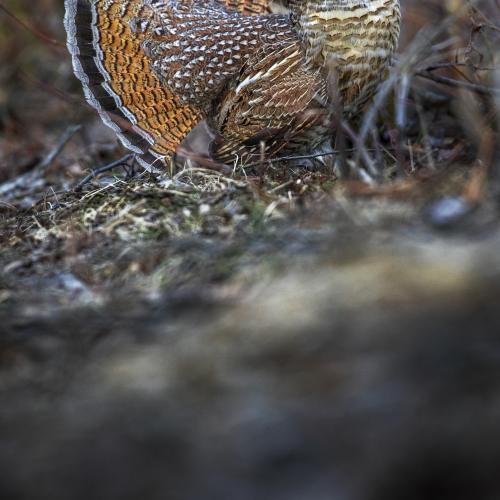
the early snow This year, we had a nice early snowfall. The ground wasn't frozen so I was able to drive deep into the forest roads and move easily through a foot of snow without slipping. This immaculate setting allowed me to see all the tracks of the night. That's how I was able to follow the tracks of a wolf for more than two kilometers. Sometimes a few Spruce Grouse and Ruffed Grouse had gone over the wolf's tracks. A little further down the road I followed two little bandits who were walking on the road. The two little raccoons seemed lost to me. Because of their size, they were young of the year. But what were they doing venturing so deep into the boreal forest? The wolf I was following was probably following them too... The snowshoe hare, like many other mammals, changes the color of its coat with the arrival of winter. It is a metamorphosis that demonstrates all the complexity of the evolution of the species according to their environment. However, for several years now, I have been noticing the double-edged sword of this ability. It is of course not instantaneous and in the case of early snow, some species become strongly handicapped. I saw this hare on the roadside sitting in the snow. In the middle of winter, I certainly would not have noticed it. His coat was slowly starting to turn white. The metamorphosis was not at all complete and gave this beast no chance to harmonize with the snow. The hares therefore became very easy prey for the wolves and lynxes who hunt these small animals on sight. Like many other northern mammals, hares are among the species sensitive to the chemical effects of light. In other words, it is one of the species influenced by the photoperiod. It is the length of the day that triggers the change in color of the coat and not the arrival of snow. This is why several species using this mode of defense are seriously endangered because of climate changes that disrupt the regular cycles of winter and snowfall. Many places in the north have lost their white coats and therefore animals with immaculate coats are becoming even more visible. However, some Mills Lab research has shown that in some populations, some individuals no longer change their coat color and remain brown year-round. It's in itself quite fascinating to see how evolution can take a new direction so quickly. So there is great hope for white winter animals to adapt!